


Retaking the SAT can be the fastest way to boost your college admission chances if you approach it with a smart plan. Here's what happens, though: many students jump into a second attempt without changing how they studied, which leads to the same disappointing results. This guide breaks down when to retake the SAT, how to really dig into your previous score, and how to build a targeted improvement plan that gets you real score gains.
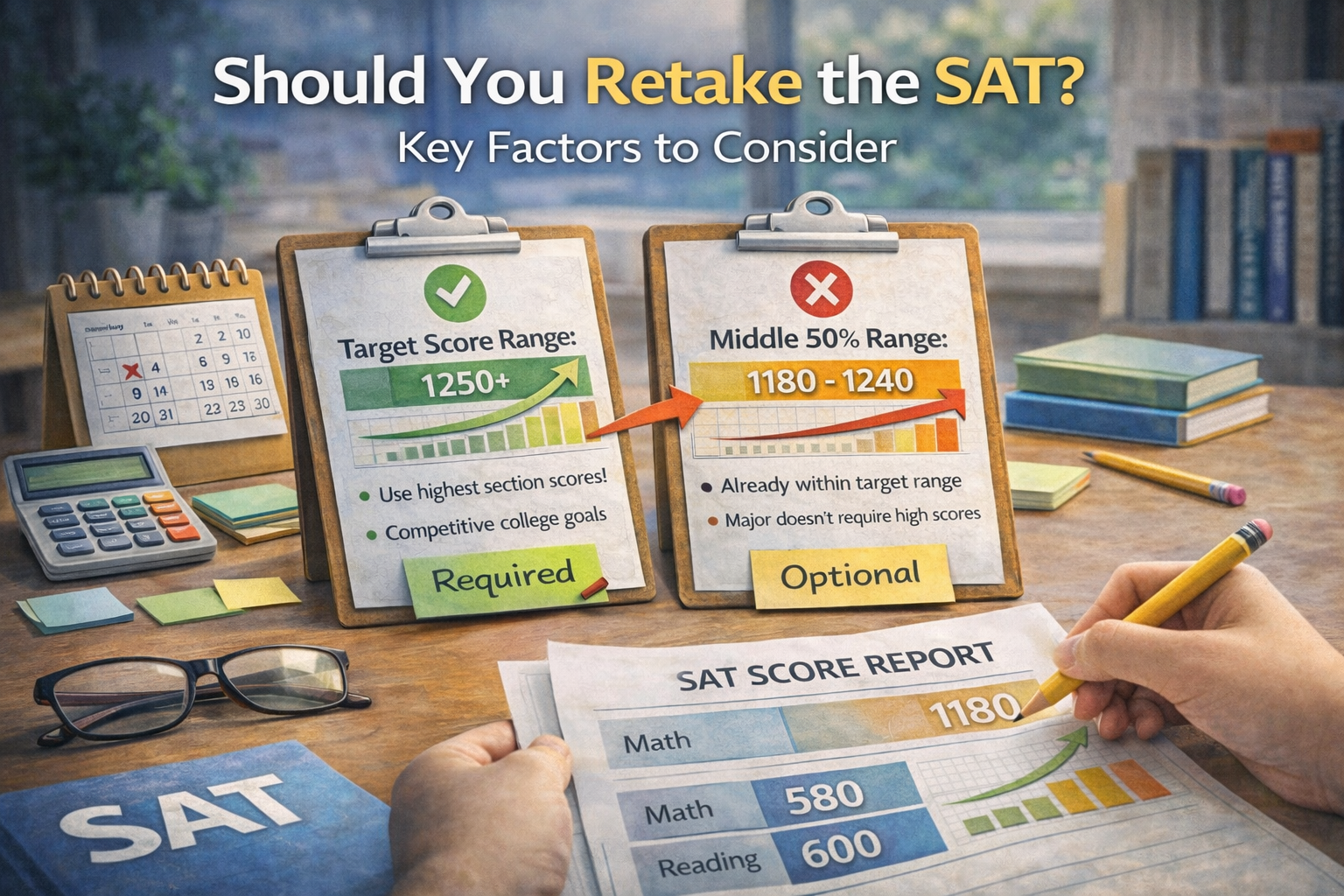
Before scheduling another test date, take a moment to understand why a retake might actually make sense and what colleges are expecting. Here's the reality: the decision to retake the SAT isn't one-size-fits-all; not every student benefits from another attempt, so assess your unique circumstances first.
Colleges typically look for upward progress when students take the SAT multiple times. Even a 50–100 point increase can strengthen an application, especially for competitive schools. Here's something encouraging: many colleges use superscoring, where they consider your highest section scores across all test attempts. So if you improve your math score on your second attempt but your reading score drops slightly, most colleges still use your best score from each section.
Sometimes a retake is basically required. For example, if your SAT score falls far below your target score range for your dream school, you'll definitely want another shot. Other times, it may be optional depending on your goals, major, and target college list. If your current SAT score already places you within or above the middle 50% range for your target schools, a retake might not make a big difference in your application strength.
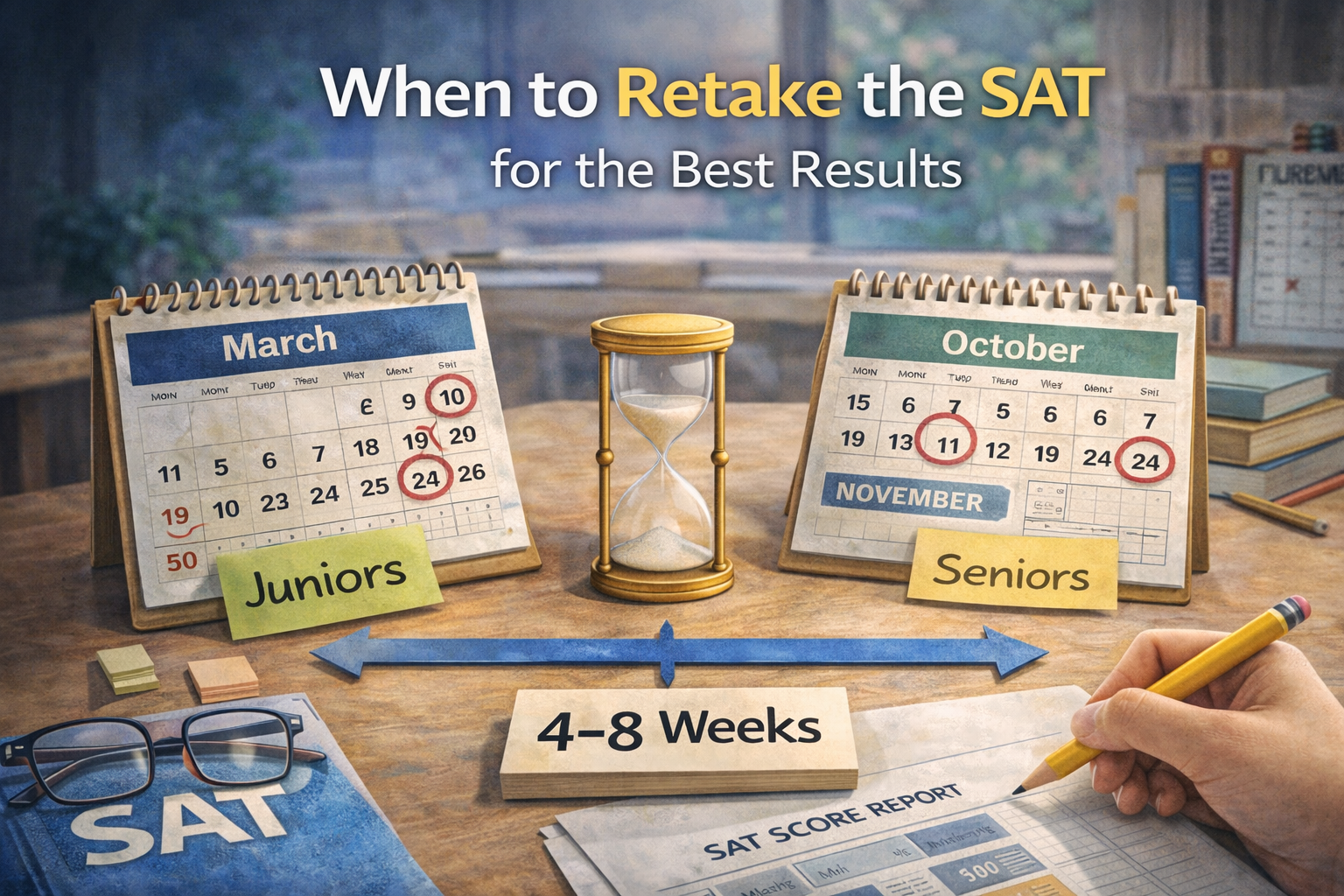
Choosing the right test date can greatly influence how much time you have to improve and how well you can integrate your prep into your school schedule.
Junior year is really the sweet spot for SAT attempts. Students who take the SAT in the spring of junior year give themselves multiple opportunities to retake the test before college applications are due. This timeline allows for a first attempt in March or May, followed by a summer of targeted prep, then a strong retake in August or October.
For senior year students, you'll need to align your retake with college deadlines. Early Action/Early Decision applicants need final SAT scores by November, making October's test date your last real opportunity.
A 4–8 week gap works best for most students, it's long enough time to actually improve but short enough time to stay warm. This timeframe allows you to identify weaknesses, build new skills, and incorporate them into your test-taking strategy without losing momentum. Students who wait too long between attempts often need to relearn material, while those who rush back within two weeks rarely see significant improvement.
Smaller targeted gains might only require 4–5 weeks of focused prep. The College Board allows students to retake the SAT as frequently as once per month, but strategic spacing improves results way more than rapid-fire attempts.
To improve, students must understand why they scored what they did. Simply knowing your total SAT score isn't enough; you really need to dig into the details.
The digital SAT provides detailed analytics through Bluebook, the College Board's official platform. After each test, you can see which modules challenged you most, review specific question stem types, and understand your adaptive pathway through the exam.
Look at your subscores within the Reading and Writing section versus math. In the language section, were vocabulary questions or grammar-based questions your weakness? These insights help you focus your prep on the weakest areas rather than wasting time reviewing concepts you've already mastered.
Did you struggle with the same type of question repeatedly? Understanding whether your errors came from knowledge gaps, timing issues, or test-taking mistakes will shape your entire improvement strategy.
For example, if you consistently miss inference questions in reading, you need to practice identifying implied meanings. If you knew the correct answer but bubbled wrong due to rushing, you need to work on time management and accuracy under pressure. Reviewing your test with this level of detail, ideally with an SAT tutoring professional, gives you a better understanding of actionable next steps.
A retake requires a different strategy, not just more practice. If you retake the SAT using the same prep routine that didn't work the first time, you're unlikely to see different results.
Decide where your effort will create the biggest score jumps. If you're consistently missing grammar rules questions, dedicating a week to mastering comma rules, subject-verb agreement, and modifier placement could add 40+ points to your score.
Catalyst helps students identify these high-impact areas through diagnostic assessments that pinpoint exactly where score gains are hiding. Instead of generic course content, you get study plans tailored to your actual test performance.
If your language section is already strong but your math score lags, allocate 70% of your prep to math and 30% to maintaining your reading and writing skills. This data-driven approach ensures every hour spent studying moves you closer to your target score.
Week 1 should focus on diagnostic review and goal setting. Weeks 2-3 involve targeted practice on your two weakest skill areas. Week 4 includes a full practice test under timed conditions. Weeks 5-6 repeat the cycle with refined focus. Week 7 is another practice test and a detailed review. Week 8 is test day preparation, lighter practice, confidence-building, and logistics planning.
This structure keeps you accountable, ensures regular assessment of progress, and builds test-taking skills progressively.
Practice smarter, not harder, to achieve meaningful gains. Random question drills won't prepare you as effectively as intentional, strategic practice.
Simulating the real Bluebook environment helps build stamina and pacing. Take each practice test at the same time of day as your scheduled test date, in a quiet space, with the same materials you'll have on test day. This trains your brain to perform under real conditions and helps you feel confident when the actual exam arrives.
Students should review mistakes deeply instead of only repeating the same questions. When you miss a question on a practice test, don't just check the answer key—really understand why you missed it. Can you explain the correct answer in your own words? Could you teach the concept to someone else?
This depth of review is where SAT prep companies like the Princeton Review and others fall short compared to personalized SAT tutoring. A good tutor or mentor will push you to articulate your thinking process and identify flawed reasoning patterns that lead to repeated mistakes.
AI-powered tools, analytics platforms, and adaptive drills accelerate improvement by serving you questions matched to your current skill level. Catalyst leverages adaptive technology combined with human mentorship to create a prep experience that evolves with you.
Most students repeat the same errors when they decide to retake the SAT. Here's how to avoid them.
Rushing to retest rarely leads to improvement. If you take the SAT again only two weeks after your first attempt without changing anything, you're essentially retaking the SAT under the same conditions that produced your original score. Give yourself enough time to build new skills and internalize new strategies.
Without changing strategy, scores rarely change. If you studied alone the first time and didn't improve, consider private SAT prep classes, private tutoring, or joining a structured program. If you used generic online materials, try a more personalized approach.
Many schools and test preparation companies offer group classes, but these often lack the individualization needed for targeted improvement. SAT tutoring with a dedicated mentor who tracks your progress and adjusts your study plans in real-time is the most effective path to a higher score.
Mindset and calmness are underrated factors in score improvement. Test anxiety can cost you 50-100 points even if you know the material cold. Developing test-taking strategies like deep breathing, positive visualization, and confidence-building routines can make a measurable difference on test day.
Practice pacing yourself and managing stress during practice tests so these skills are automatic on the real exam.
Catalyst has helped students achieve dramatic score improvements through a combination of diagnostic precision, personalized study plans, and expert mentorship.
Catalyst begins with comprehensive diagnostics that go deeper than College Board analytics. We identify not just what you got wrong, but why—whether it's conceptual gaps, timing issues, or test-taking errors. This creates a roadmap for improvement that's unique to you.
Our platform shows you exactly which question types, which math concepts, and which reading skills need work. This approach consistently allows students improve faster than those using off-the-shelf prep materials.
Catalyst's SAT tutoring connects you with a dedicated mentor who follows your development, your tactics, and your confidence. Your mentor reviews every practice test and discusses your problem-solving skills in depth.
This personal connection is what separates Catalyst from other prep options. We've worked with students across all skill levels and consistently see transformative results when students commit to the process.
Most students take the SAT 2–3 times, but the quality of prep matters more than quantity. Many colleges accept multiple attempts and will consider your best score through superscoring.
Many students see 80–200 point improvements with a proper strategy. The key is diagnosing weaknesses accurately and implementing targeted practice with accountability and expert guidance throughout your prep cycle.
You can retake the test once a month according to College Board rules, but strategic spacing improves results. A 4–8 week gap allows for meaningful skill development and better test scores on your next test attempt.


